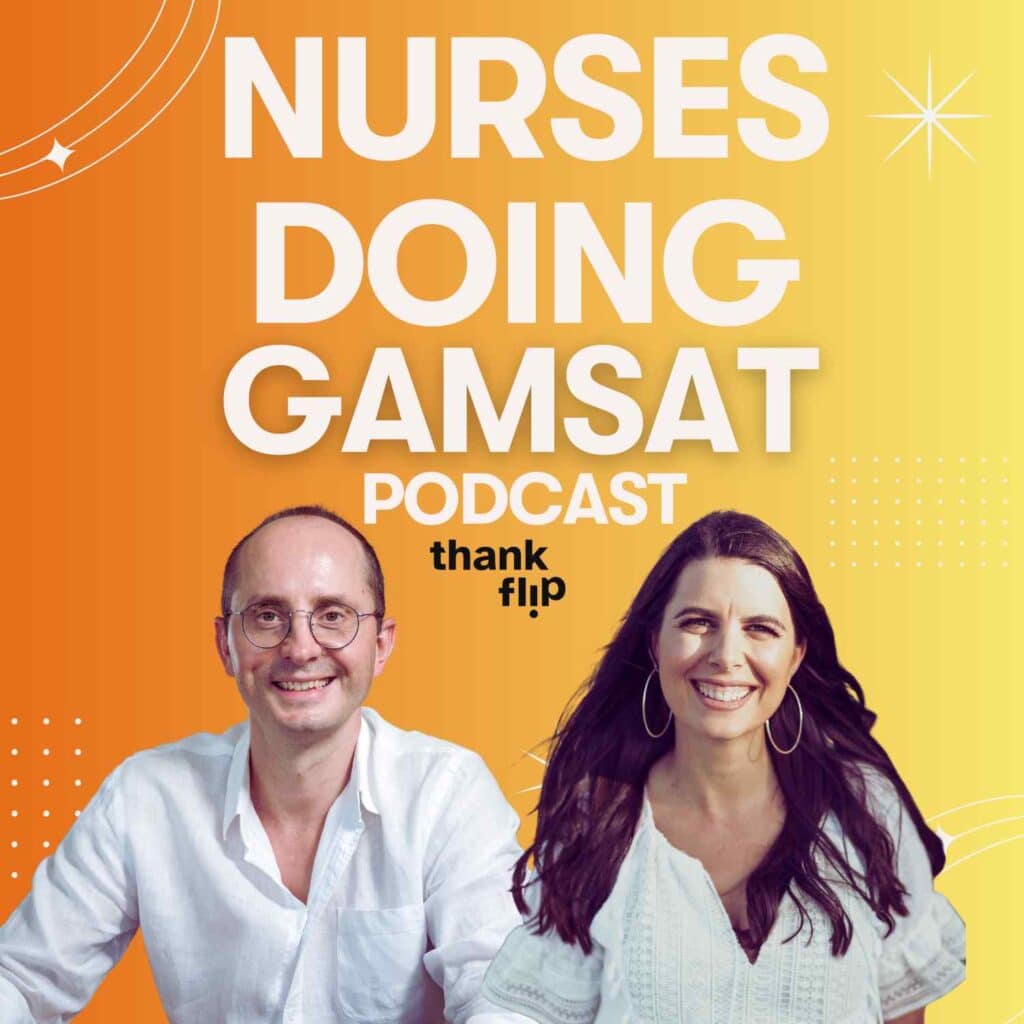
In This Episode:
If Section 1 of the GAMSAT feels like a mystery, this episode breaks it down for you. Dr Tom sits down with Ryan — a PhD in creative writing and philosophy — to unpack exactly what “Reasoning in Humanities and Social Sciences” is all about. Together, they dive into how to read GAMSAT-style passages, interpret tone and intention, and build the mindset you need to think like a high scorer. Whether you’re a nurse or healthcare professional tackling Section 1 for the first time, this chat will help you study smarter, not harder — and actually enjoy the process.
Resources Mentioned:
- Join our Nurses Doing GAMSAT Facebook group for any questions
- Get our free Section 1 practice test
- Get started with this short Section 1 reading list
Tom (00:03)
Welcome back everyone to the Nurses Doing GAMSAT podcast. I’m Dr Tom, founder and CEO of ThankFlip GAMSAT, and I’m joined today by our lead tutor for Section One and lecturer, Ryan. He has a PhD in Creative Writing and Philosophy from the University of Edinburgh, a Master’s in English Literature, and he’s helped hundreds of students in our program through his live lessons and recorded sessions.
Today we’re going to talk about an overview of Section One — how it works, what’s involved, and how to prepare for it. We’ll start with the big picture and then get into some details. Before we dive in, if you’d like any of the resources we talk about today, or more help with your GAMSAT preparation, head to the show notes — we’ll have links and resources there for you.
Welcome, Ryan, to the podcast.
Ryan (01:05)
Hi Tom, thank you very much. Hi everybody.
Tom (01:09)
You’re in Italy right now, right?
Ryan (01:12)
Yeah, in Northern Italy — a city called Trento, in the region of Trentino. It’s a very beautiful part of the world.
Tom (01:21)
And when we met, you were in Berlin.
Ryan (01:24)
Yeah, I was. That was towards the end of the COVID period in Britain.
Tom (01:30)
And you’re originally from South Africa, so you’ve had quite an international life! It always sounds so exotic when you tell me where you are. I’m sure it sounds the same to you when I talk about Australia.
Ryan (01:35)
Yeah, exactly. I’d love to meet you in person — which we’ve never done! One day I hope to come to Australia, to the sunshine.
Tom (01:52)
Fingers crossed — I’ll hold you to that. Here on the Sunshine Coast, it’s warming up now for mid-spring. Getting warm — that’s why I’m dressed for it. Shorts on, business shirt, relaxed pants. But let’s jump in.
Ryan (02:03)
You can see me — I’m dressed for autumn.
Tom (02:19)
Today we’re talking about Section One. We’ll start broad and then get more detailed. Firstly, let’s talk about the format. For those who don’t know, it’s called Section One because traditionally it’s the first section you sit. Recently they’ve changed the order slightly, but it’s still called Section One — Reasoning in Humanities and Social Sciences.
It’s 62 questions in 100 minutes, done on a computer at a testing centre. It’s multiple choice, with four options per question.
The topics are quite broad and vague — even ACER’s descriptions don’t really pinpoint what subjects or question types will come up. So let’s talk about that today. Ryan, what’s your impression of the kinds of topics that appear in Section One?
Ryan (03:24)
Yeah, I remember when I first started it was all new to me — the GAMSAT exam and its different sections. You gave me some tests and exams to try myself, and I remember in those early papers there was a lot of drama — as in plays — which has become less common over the years, though it could come back.
Generally, though, the topics include cartoons, poetry, nonfiction, and fiction.
Tom (03:53)
Yep. They’ve gotten quite creative with some of the passages. The stimulus material is usually text-based, but sometimes they include diagrams or tables — maybe data you have to interpret, or an editorial cartoon.
Usually, though, it’s text — fiction, which could be modern or classic, or nonfiction, which can include material from Freud, philosophy, or social commentary. You’ll often see opinion pieces — multiple short paragraphs from different sources on the same topic, each with a different perspective. You then have to weigh and compare them, which can be tricky.
From your experience, Ryan, what have been the most challenging passages or topics for students?
Ryan (05:25)
I’ve noticed that sometimes nonfiction passages have some link to the medical profession — understandably, since students taking the exam want to become doctors.
But the exam writers don’t usually choose contemporary medical texts that students might be familiar with. Instead, they use older material — as you mentioned, Freud, or writers from the late 18th or early 19th century. The language is very different — verbose, full of what I call fluff.
So it’s about helping students cut through that fluff to find the core meaning. Modern writing tends to be pared down, whereas older writing is more elaborate, which makes interpretation harder.
Tom (06:55)
Yeah, exactly. That’s one of the biggest challenges — both fiction and nonfiction passages can be tough. You think “fiction — that’s just a story,” but the language can be confusing, or the passage is long and dense, so students end up rereading it and running out of time.
Ryan (07:50)
Yes.
Tom (07:51)
So that’s the stimulus material. Then you have the questions — they might ask about meaning, tone, logic, or the author’s intent. What are some of the question types you’ve seen, Ryan?
Ryan (08:23)
Well, many questions test how intuitively you can read and interpret meaning. You told me early on that Section One is really testing a student’s empathy — their ability to understand human situations and emotions through reading.
I found that fascinating. It’s a unique approach and, I think, a very good one.
Tom (09:18)
Yes. At first it seems like a simple comprehension test — and it is, to a degree — but it’s deeper than that. Students might understand the surface meaning, but the exam digs for more: the author’s intentions, tone, mood, and the implications of actions.
Ryan (09:53)
Exactly. The questions often ask, “What does the author mean by this?” or “What’s the tone or mood?”
Across all of Section One — fiction, poetry, nonfiction, even cartoons — it’s really about communication. Not just verbal communication, but non-verbal too. In fiction, for instance, you have to interpret characters’ body language, expressions, and motivations. You’re expected to intuit emotion and intent.
Tom (11:27)
Yes, even with data or graphs — you have to interpret what’s being communicated.
Since you mentioned fiction, let’s talk about your background — because you’re a fiction author yourself. Tell us a bit about that.
Ryan (12:18)
It all started with reading. Every author says that — you can’t be a writer if you don’t read. My relationship with reading and writing began with books. It taught me to observe the world differently — to notice how people speak, their mannerisms, their use of language.
Language is my medium, my tool. So it’s fascinating for me to work on the GAMSAT program, helping students analyse texts in this way.
Tom (14:02)
When we met, you’d already completed your Master’s and PhD. Can you tell us more about those?
Ryan (14:12)
Sure. My degree in South Africa, at the University of Cape Town, was a four-year program in Philosophy and English Literature — including American and South American literature.
Later I moved to Italy, and then to London to do a Master’s in Creative Writing at Kingston University. There I learned the craft — workshops, analysing others’ writing, and refining my own.
I’ve been hooked ever since. As a writer, you always feel you can do better — because both you and language are constantly evolving. I love short stories especially — they open a window into a person’s life in just a few pages.
Tom (15:35)
And how does that help you interpret other people’s writing — say, in a GAMSAT passage?
Ryan (15:53)
Good question. There’s a line from Dostoevsky’s Crime and Punishment: a character says, “I was ruined by books.” It resonated with me because once I started writing seriously, I could no longer just read for pleasure. I began analysing everything — how an author achieved an effect, the “scaffolding” behind the story.
Good writing hides that scaffolding; bad writing makes it obvious. So when I read fiction, nonfiction, or poetry, I can see what the writer’s doing — and that helps me teach others to recognise it too.
Tom (17:34)
That’s exactly it. When I started GAMSAT, I didn’t read much, but I realised reading helps you understand other people’s worlds — and writing helps others understand yours.
Students who take Section One seriously often go through that same shift. They start noticing meaning, tone, and subtlety in writing — and even in life.
From your teaching experience, what do students struggle with most?
Ryan (18:50)
Honestly, I think it’s that people just don’t read as much anymore. I teach both high school and university, and it’s a global trend — people’s attention spans are shorter because of smartphones and social media. I’m guilty too — the constant dopamine hits make it addictive.
Students often lack the focus to stick with long, dense passages. Plus, many prioritise their strengths — the sciences and maths — and neglect humanities practice.
Tom (19:42)
Yeah, it’s like a poker machine!
Ryan (20:00)
Exactly. And because Section One draws on literary skills they haven’t used since high school — poetry, fiction, literary devices — they find it tough.
Our students come from varied backgrounds — recent graduates, career-changers, older applicants — so the challenge is universal: reading outside their comfort zone.
Tom (21:47)
That’s a great point. Section One really pushes you to read things you wouldn’t normally. So what works best in terms of preparation?
Ryan (22:00)
I use a kind of analogy: if you’re weaning someone off an addiction, you reduce the dosage gradually. With reading, it’s the opposite — you have to build up a habit gradually.
If someone rarely reads fiction or poetry, start small — like a daily dose.
Tom (23:18)
Ten or fifteen minutes a day?
Ryan (23:24)
Exactly. Build consistency. If you only read when doing practice exams, it’s not enough. There’s such variety in the real test — constant practice helps you adapt.
Tom (23:58)
That’s a healthy addiction!
Ryan (24:15)
I’m fully addicted.
Tom (24:20)
So what should students actually do while reading? Not just glance over it — how should they think?
Ryan (24:24)
Good question. Many students, especially in our Power Call sessions, worry because they don’t understand the text straight away. They expect to grasp the whole meaning immediately, and when they can’t summarise it, they panic.
But the key is to focus on the parts before the whole. Not every sentence carries equal weight — some add meaning, others are just padding or “fluff.” You learn to identify the meaningful parts — and that’s where the answers usually come from.
Tom (26:39)
So if you’re reading something difficult, like Freud, how do you break it down?
Ryan (27:03)
Freud’s a good example. As the founder of psychoanalysis, he was inventing language as he wrote — terms like ego, superego, and id didn’t exist before. He was experimenting, explaining, and revising as he went, so his writing can be dense.
The trick is to distil his paragraphs down to the essential ideas. Pay attention to punctuation — commas often introduce clarifying phrases. If you can spot the main clause and the side clarifications, you can strip a long paragraph to its core meaning.
Of course, you can’t do that for the first time on exam day — you need to practise this skill beforehand.
Tom (30:09)
Exactly. Freud’s a tough example!
Ryan (30:22)
Yes — and the same applies to other old writers like Karl Marx or Darwin. Their style is long-winded, but if you focus on key verbs and ideas, you can find the essence.
Tom (30:45)
And context helps too — in the GAMSAT they tell you who the author is or what the text is from, which gives clues. Knowing it’s Freud or Darwin or a particular period sets expectations for the style and content.
Ryan (31:41)
Yes, and the questions also guide you. Some students read the passage first; others look at the questions first. I suggest reading the questions first — underline the keywords so your brain starts making connections as you read the passage.
It’s a technique from other language exams like Cambridge or IELTS — time is short, so you train your mind to find those cues quickly.
Tom (33:17)
Right — so you know what to look for.
And there’s an important distinction here. What you’re describing is strategy for exam day or practice papers, but before that, students should spend time simply reading and analysing widely — as we do in bootcamp — to build those foundational skills.
Ryan (34:38)
Exactly. Because if you tell someone “read widely,” they might not know where to start.
Tom (34:46)
Yes, that’s true.
Ryan (35:07)
Coming from South Africa, I often use the idea of the “Big Five” — and for English literature, you might think of Shakespeare, Milton, Emily Dickinson, Charles Dickens… different eras, but key figures.
Everyone has their own Big Five, but Shakespeare is universal — and he comes up a lot in GAMSAT. He wrote both plays and poetry. It can feel like another language at first, but like any language, you get more fluent with practice.
Tom (36:06)
Yes.
Ryan (36:33)
By my final year of high school, I could read Shakespeare comfortably. I think focusing on major writers helps — and you start to notice certain names recur in exams: Shakespeare, Darwin, Freud, Emily Dickinson.
There’s also the Norton Anthology — a great reference. You can find second-hand copies cheaply, and they include historical context, sample texts, and commentary. You don’t have to read it cover to cover, but it’s a fantastic resource to dip into.
Tom (38:06)
Great tip. We’ll include a list of past GAMSAT texts in the show notes, plus a Section One diagnostic test so listeners can identify their weaknesses and work on them.
We’ve covered a lot today. Next time, we’ll have Ryan back to talk about everyone’s favourite topic — poetry — and do a deep dive into that.
For now, thank you, Ryan, for joining us. If you’d like more help, check the show notes — you can book a session with Ryan, join our bootcamp, or get extra support with your prep.
Ryan (38:48)
You’re welcome. Thanks, everybody.
Tom (39:05)
Thank you, Ryan — and see everyone next time.
Ryan (39:09)
Thanks, Tom. Thanks everyone. See you.
Watch Now on YouTube:
Ready to Make This GAMSAT Your Last? Book a FREE 1-on-1 Call Now!
Before You Go — Get Your Freebie!
Click here download The GAMSAT Manifesto — our free GAMSAT study guide that has (so far) helped more than 60,000 people crush this highly unusual exam. Oh yeah, and did we mention…it’s free?