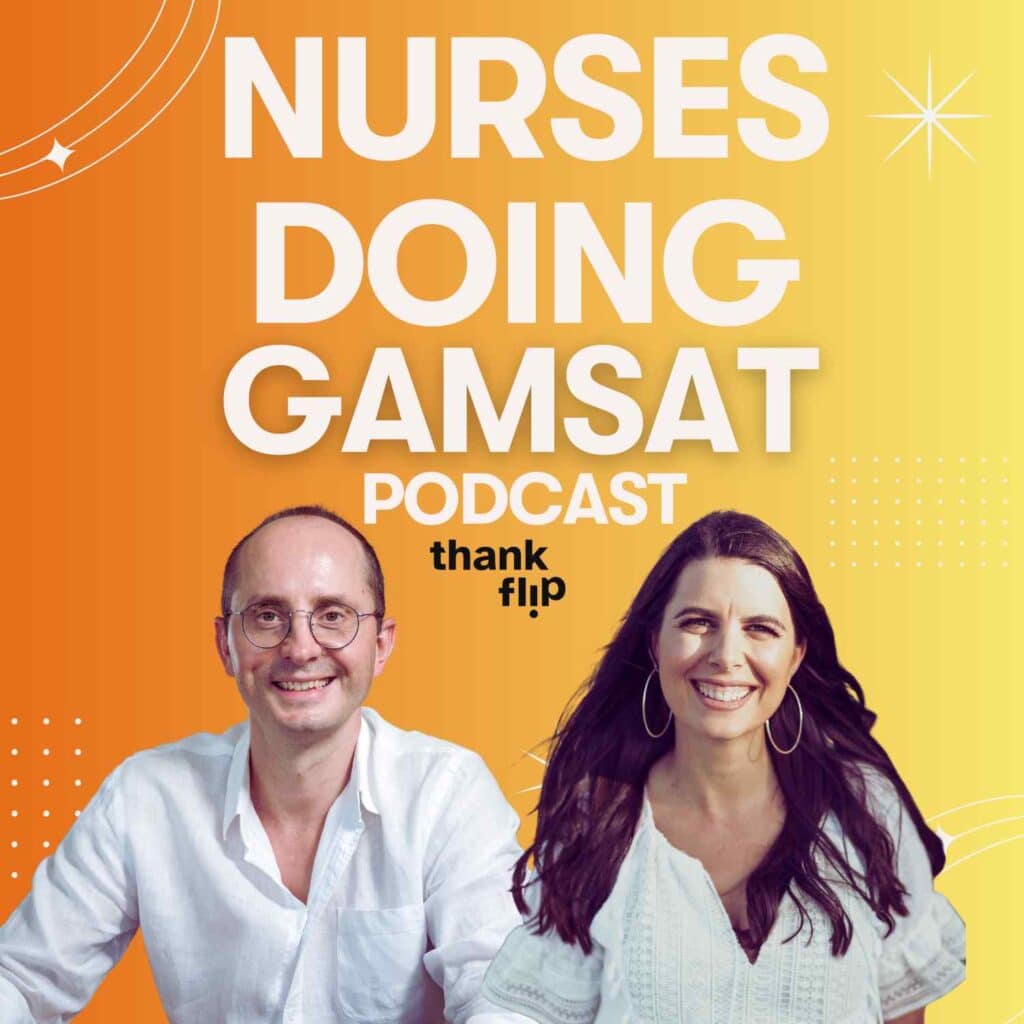
In This Episode:
If GAMSAT Section 2 feels like the most intimidating part of your medical school journey, this episode is for you. Dr Tom sits down with Bella Neville, who transformed a struggling essay score into an impressive 83, to share practical GAMSAT essay writing tips, effective GAMSAT study techniques, and the mindset shifts that helped her succeed. Whether you’re looking for the best GAMSAT resources for nurses, struggling with idea generation, or wondering how to prepare for GAMSAT as a nurse or healthcare professional, you’ll learn actionable strategies to improve your essays and approach the exam with confidence. Tune in to discover why success in Section 2 isn’t about perfection—it’s about thinking deeply, trusting your ideas, and developing the skills needed for medical school in Australia.
Resources Mentioned:
- How to come up with 4 essay ideas in 36 seconds
- Get our essay “Fast Growth Formula” to help you improve your essays fast
- Learn podcast episode Ep 26: GAMSAT Essays – What You’re Not Told, But Absolutely
Dr Tom (00:17)
Yeah, ready to go? Awesome.
Bella Neville (00:18)
Ready to go.
Dr Tom (00:20)
Alright. If you’re a nurse, a science student, or a healthcare worker preparing for the GAMSAT, there’s a good chance Section 2 feels a little bit weird. Maybe that’s the weird section for you. Section 3 feels like science, Section 1 feels like reading, but Section 2? Suddenly you’re expected to write two thoughtful essays under time pressure about topics you don’t think about much, like politics, taxation, justice, ambition, pity, originality, regret, truth, or whatever themes the essay section feels like throwing at you on the day.
If that sounds terrifying, then today’s episode is going to help you.
Welcome back to the Nurses Doing GAMSAT podcast. We’re here to help nurses, healthcare professionals, science students, and future doctors prepare for the GAMSAT.
I’m Dr Tom, founder of ThankFlip GAMSAT, and today I am joined by Bella, who leads our Section 2 team. Hi Bella.
Bella Neville (01:21)
Hi Tom, how are you?
Dr Tom (01:23)
Very good. Thanks for joining us.
Just to give you a quick introduction, Bella scored an 83 in the essay section, even though she initially thought it would be her worst section and was quite worried about it. She is also on her way to studying medicine in the UK. Is it St George’s?
Bella Neville (01:48)
It is, yes.
Dr Tom (01:49)
It is St George’s. Excellent.
In today’s episode, we’re going to talk about what Section 2 actually is, why students struggle with it, how to overcome those problems, and how Bella prepared, going from a section she struggled with to one she clearly thrives in. We’ll also discuss what you can do to start your preparation and give yourself the best chance of doing well.
We’ll also talk about our Acceleration Classes, which are starting very shortly. As always, the resources and links to everything we discuss will be in the show notes, so scroll down and you’ll find them there.
So Bella, before we get into essays, let’s talk a little about your GAMSAT experience. You’ve had quite an interesting journey. It even involved a broken foot at one point, so it’s not exactly been a smooth ride for you.
Tell us a bit more. When did you decide you wanted to do medicine?
Bella Neville (02:40)
Yeah, I was one of those weird kids who knew what they wanted to do from quite a young age.
From about eleven, apparently, I was saying that I wanted to be a doctor. I wanted to study medicine. Throughout school, it was always my goal.
I looked into the UCAT but didn’t end up sitting it. Instead, I completed a Bachelor of Pre-Medicine and then realised I’d have to sit the GAMSAT.
Much to my disgust, I was horrified. I remember thinking, “Why does this have to be something I need to do?”
But it was, so I looked into it, researched what was involved, and was completely terrified at the thought of having to do writing and reading again.
The science section had this sense of mystery around it, but there was also some comfort because I thought, “Well, I’m a science student. I should be able to do that.”
The essay section, though, was the one that really worried me. I just kept thinking, “What am I going to do?”
Writing was never a strength of mine. I was always told I was a waffler. My English teachers would constantly say, “You write too much. Get to the point.”
So I was thinking, “What am I going to do now? I’ve finished school. I’ve finished uni. Essays were supposed to be behind me, and now I’m back writing them again.”
Dr Tom (04:55)
I was caught up in the whirlwind of what everyone says about the GAMSAT.
“It’s so hard.”
“You can’t study for it.”
“If you don’t know physics, you’re screwed.”
And I remember thinking, “Well, I am screwed then.”
But then ThankFlip came along, and I got started with a lot of enthusiasm. I submitted my first set of essays and scored 28 out of 100.
Bella Neville (05:13)
I was floored.
Dr Tom (05:15)
Yeah, that’s often a shock when people receive feedback on their first essays.
Bella Neville (05:23)
Absolutely. I remember thinking, “Well, this seals my fate. It’s going to be my worst section. This isn’t going to work.”
I was wondering, “Where do I go from here?”
But it was the support from ThankFlip, the Section 2 team, and a huge mindset shift that happened towards the end of my preparation.
It wasn’t until the second-last Acceleration Class that something finally clicked.
I realised I’d been looking at the whole thing the wrong way.
I was treating the essay section like an English class. I thought I had to write essays the way examiners wanted, sound intelligent, and somehow produce the perfect response.
Then I realised that’s not what it’s about at all.
It’s about showing your empathy, your perspective, and your understanding of the world.
It’s not about perfection. It’s about putting yourself on the page and demonstrating the qualities that would make you the kind of doctor you aspire to become.
That was a really important moment for me.
Bella Neville (06:26)
So then I sat my first GAMSAT in September 2024, and everything went so smoothly for Section 2. It was smooth sailing. The proctor was lovely, I felt pumped, I was ready, and I sat the exam.
I remember feeling absolutely buzzed afterwards.
Then the post-exam doubts started creeping in.
You start thinking, “Did I really write that? That doesn’t sound very good.”
You go through the post-mortem and sit there wondering whether it was actually any good. But eventually you accept that it’s done and there’s nothing you can change.
Thankfully, I was very happy with my first result, scoring 83.
I ended up sitting the GAMSAT again because I first sat it in my penultimate year of university, and I thought I’d have another go and see if I could improve my score.
So I sat again in March 2025.
The night before the exam, I was preparing our family study for the online proctored exam. I was moving everything off the desk, putting sheets over cabinets, and getting the room ready.
My brother has a big monitor with a large computer tower underneath it. I thought if I grabbed it by the arm and supported it underneath, it would carry nicely.
Well, it didn’t.
The computer tower flipped and landed directly on my foot.
Dr Tom (07:47)
Which is not exactly ideal preparation the night before the GAMSAT.
Bella Neville (07:51)
Not ideal at all.
I remember looking down and thinking, “That doesn’t look good.”
The next thing I knew, I was at the hospital having X-rays done.
Turns out I’d fractured my foot.
So I sat the GAMSAT the next day with a broken foot.
Dr Tom (08:10)
That’s commitment.
Bella Neville (08:12)
Honestly, there wasn’t really another option at that point.
I’d worked so hard to get there and wasn’t going to let a broken foot stop me.
Looking back now, it’s a funny story, but at the time it definitely wasn’t funny.
Dr Tom (08:28)
It’s one of those stories that’s funny afterwards.
Bella Neville (08:31)
Exactly.
Dr Tom (08:35)
Let’s talk about Section 2 itself.
A lot of people hear “essay section” and immediately panic.
Can you walk us through what Section 2 actually is and what students are expected to do?
Bella Neville (08:48)
Absolutely.
Section 2 consists of two essays that you write under timed conditions.
The first thing that’s really important to understand is that writing is actually the second task.
The first task is figuring out what the theme is asking you to discuss.
A lot of students jump straight into writing, but they haven’t actually unpacked what the quotes are about.
You need to be able to identify the theme first, and then decide how you’re going to respond to it.
Dr Tom (09:15)
That’s such an important distinction because people often think the challenge is the writing.
Bella Neville (09:20)
Exactly.
The writing matters, but if you’ve misunderstood the theme, then it doesn’t matter how well you write.
You need to know what conversation you’re actually entering.
Dr Tom (09:30)
And that’s often where people come unstuck.
Bella Neville (09:33)
Definitely.
The essay section isn’t really testing whether you’re the world’s greatest writer.
It’s testing how you think.
It’s testing whether you can take a broad theme, interpret it, form ideas around it, and communicate those ideas clearly.
Dr Tom (09:49)
Which is actually a very different skill from what most people expect.
Bella Neville (09:53)
Exactly.
And I think once people understand that, it becomes a lot less intimidating.
It’s not about having the perfect vocabulary or sounding intellectual.
It’s about being thoughtful.
It’s about being able to engage with ideas and show insight.
Dr Tom (10:10)
So when students are first looking at these themes, what do you recommend?
Bella Neville (10:14)
The biggest thing is slowing down.
People want to rush because they’re under time pressure, but if you spend a little more time understanding the theme, you’ll usually write a much better essay.
It’s worth investing that time upfront because it makes everything else easier.
Once you’ve identified the theme properly, you can start generating ideas that actually fit what the prompt is asking.
And that’s where things start becoming much more manageable.
Dr Tom (14:28)
One of the biggest challenges students face is understanding what the two tasks are actually asking of them.
Bella Neville (14:28)
Exactly.
Having the ability to identify the theme is the first task, and writing the essay is the second. They’re two separate skills.
Task A, Essay One, typically focuses on social and cultural themes. These are the big-picture topics that affect society, culture, and the world we live in.
Think topics like commercialism, government, politics, democracy, capitalism, communism, hunger, or farming. They’re broad themes that have a societal impact.
These essays generally require a more academic approach. You want stronger language, stronger ideas, and a more logical, well-thought-out argument.
Dr Tom (14:53)
Politics seems to come up all the time.
Bella Neville (14:56)
It really does.
Dr Tom (14:58)
Politics, capitalism, communism — they seem to love rotating through those kinds of themes.
Bella Neville (15:05)
Exactly.
They all come back to societal impact and how larger systems affect people and communities.
Then we move into Task B, which is a completely different kettle of fish.
Task B is much more personal.
The themes tend to be emotionally driven and reflective. You might see topics around regret, sadness, happiness, motivation, hope, love, or even something as unexpected as loving your pets.
These themes require much more introspection and reflection.
They ask you to show your human side rather than simply your logical side.
Dr Tom (15:35)
So it’s almost like you’re demonstrating a different set of skills.
Bella Neville (15:35)
Exactly.
The essay section is this interesting combination of two very different styles of thinking.
One side showcases your academic abilities, your understanding of ideas, and your ability to form and defend arguments.
The other side showcases your ability to connect with people, empathise, reflect, and think deeply about human experiences.
Both of those skill sets are incredibly important for medicine.
Dr Tom (16:05)
And that’s what makes the section so unique.
Bella Neville (16:05)
Absolutely.
You’re demonstrating two sides of yourself.
On one hand, you’re showing that you’re thoughtful, informed, and capable of analysing complex issues.
On the other, you’re showing that you’re empathetic, reflective, and capable of understanding people and their experiences.
Those are both qualities that medical schools are looking for.
Dr Tom (16:30)
Which makes sense when you think about what doctors actually do.
Bella Neville (16:34)
Exactly.
Medicine isn’t just science.
It’s people.
It’s understanding systems, but it’s also understanding human beings.
The essay section is one way of assessing both.
Dr Tom (17:00)
One of the questions we get asked all the time is, “Why do people struggle with Section 2?”
What do you think are the most common problems students face?
Bella Neville (17:28)
The first thing that comes to mind is coming up with ideas.
I think a lot of people have this misconception that their ideas need to be perfect.
They think they need to sound incredibly intelligent or come up with something revolutionary.
That’s simply not the case.
At the end of the day, no idea is perfect.
The GAMSAT markers aren’t looking for one specific “correct” answer.
They’re looking at how you engage with the theme.
They’re looking at how you use your knowledge, your experiences, your foresight, your hindsight, and your understanding of the world to create a meaningful response.
Those are all qualities that we need as future doctors.
Dr Tom (17:53)
Exactly.
Bella Neville (18:00)
Coming up with ideas is probably the biggest challenge because it’s the foundation of everything else.
If you don’t have an idea, it’s very difficult to move forward.
But having an idea doesn’t mean it has to be perfect.
It just needs to be something you can confidently write about.
Another challenge people face is having either too many ideas or too few.
Students look at these themes and they’re huge. They’re intentionally broad.
And they’re broad for a reason.
The exam wants you to bring your own perspective to the theme.
If the themes were very narrow, everyone would end up writing essentially the same essay.
Dr Tom (18:43)
And then you lose that individuality.
Bella Neville (18:46)
Exactly.
The broadness allows people to bring their own experiences, insights, and viewpoints into their writing.
That’s where the individuality comes from.
Dr Tom (18:52)
So is it about having an opinion, or is it more about insight? What’s actually happening there?
Bella Neville (19:01)
I think it’s more about insight.
You don’t necessarily have to have a strong opinion on every topic.
But you do need to be able to think about it, explore it, and offer meaningful observations.
That’s where strong essays often come from.
Dr Tom (19:01)
That’s really interesting because I think a lot of people get caught up trying to figure out what the “right” answer is.
Bella Neville (19:08)
Exactly.
And there isn’t really a right answer.
It’s more about whether you can take a theme, think deeply about it, and present your perspective in a thoughtful and coherent way.
Two people can write completely different essays on the same theme and both do very well.
Dr Tom (19:23)
Which is often reassuring for students to hear.
Bella Neville (19:26)
Absolutely.
I think sometimes students feel like they need to guess what the markers want.
But that’s not really the goal.
The goal is to show how you think and how you engage with ideas.
Dr Tom (19:40)
So we’ve talked about generating ideas. What comes next?
Bella Neville (19:44)
Structure.
I think weak structure is one of the most common issues students face.
A lot of people have an idea, but they don’t know how to present it.
They’re wondering, “How do I turn this into an essay?”
“How do I write a thesis?”
“How do I organise my argument?”
They’re all really common questions.
Honestly, they’re questions I still ask myself sometimes.
I’ll still look at something and think, “Is this actually a thesis?”
Dr Tom (20:05)
I think everyone does that.
Bella Neville (20:07)
Exactly.
The challenge is learning how to communicate your ideas in a way that’s logical, clear, and focused.
You want the marker to be able to follow your thinking.
You want them to understand your perspective, your evidence, and your reasoning.
And you want all of that presented in a concise and coherent way.
Dr Tom (20:28)
That’s a really important point.
Because even a fantastic idea can get lost if the structure isn’t helping the reader follow along.
Bella Neville (20:35)
Exactly.
Structure is what carries the reader through your thinking.
Without it, even strong ideas can become confusing.
Dr Tom (20:45)
And a lot of the students I speak to tend to fall into one of two camps.
They’re either saying, “I don’t have enough ideas,” or they’re saying, “I have too many ideas and I don’t know which one to choose.”
Bella Neville (21:00)
Yes.
Dr Tom (21:00)
Then there are the students who look at a theme and think, “I’ve never thought about this before. I have absolutely no idea where to begin.”
Bella Neville (21:07)
Exactly.
Dr Tom (21:10)
So once you’ve overcome that issue and you’ve got an idea, the next challenge is turning it into something coherent.
Bella Neville (21:15)
Yes.
And that’s where structure becomes so important.
A lot of people underestimate just how much easier writing becomes when you have a clear framework.
You’re no longer staring at a blank page wondering what comes next.
Instead, you’re following a process.
Dr Tom (21:30)
And that’s often where students start gaining confidence.
Bella Neville (21:33)
Definitely.
Because once you know how to structure your ideas, you’re no longer relying on inspiration.
You’re relying on a process.
That makes writing much less intimidating.
Dr Tom (21:45)
Which is a really important distinction.
People often think good writers sit down and magically produce great essays.
Bella Neville (21:50)
Exactly.
Most good writers have systems.
They have frameworks.
They have ways of organising their thoughts.
That’s what makes the process repeatable.
Dr Tom (21:58)
And that’s especially important in the GAMSAT because you’re writing under time pressure.
Bella Neville (22:03)
Absolutely.
You don’t have time to sit there waiting for inspiration to arrive.
You need a structure that allows you to take an idea and quickly develop it into an essay.
Dr Tom (22:18)
So structure becomes one of those foundational skills that students really need to develop.
Bella Neville (22:23)
Exactly.
A structure that is clear, logical, and flows well makes a huge difference.
It helps you communicate your ideas effectively and gives the marker confidence in your thinking.
And ultimately, that’s what you’re trying to achieve.
Dr Tom (22:23)
So once students start improving their structure, what do you think the next step is?
Bella Neville (22:28)
I think the next step is learning how to actually analyse ideas.
A lot of students can come up with a point, but they stop there.
They’ll make a statement and then move straight on to the next statement.
What really separates stronger essays is the ability to explore an idea more deeply.
Dr Tom (22:45)
Can you give an example of what you mean by that?
Bella Neville (22:48)
Sure.
Let’s say you make a statement about ambition.
A lot of students might simply say, “Ambition drives success.”
That’s a fine starting point, but the real question is: why?
Why does ambition drive success?
When does it drive success?
Are there situations where ambition becomes harmful?
What happens when ambition is unchecked?
Those are the kinds of questions that deepen an essay.
Dr Tom (23:10)
So it’s about unpacking ideas rather than just listing them.
Bella Neville (23:13)
Exactly.
The strongest essays aren’t necessarily the ones with the most complicated ideas.
They’re often the ones that explore ideas thoroughly.
Dr Tom (23:20)
I think that’s something students often overlook.
They assume they need more examples when sometimes they simply need more analysis.
Bella Neville (23:26)
Absolutely.
Sometimes students jump from example to example without fully explaining why those examples matter.
The analysis is where you demonstrate your thinking.
That’s where the marker can really see your insight.
Dr Tom (23:40)
And that’s often what people mean when they talk about depth.
Bella Neville (23:43)
Exactly.
Depth isn’t about using bigger words.
It’s about exploring ideas more thoroughly.
It’s about asking more questions and following those questions through.
Dr Tom (23:55)
Which is actually a skill that’s useful far beyond the GAMSAT.
Bella Neville (23:58)
Definitely.
It’s a skill you’ll use throughout medicine and throughout life.
Learning to think deeply about ideas helps you become a better communicator, a better problem solver, and ultimately a better clinician.
Dr Tom (24:15)
So when you were preparing, what specifically did you do to improve your ability to come up with ideas?
Bella Neville (24:22)
One of the biggest things I did was stop trying to memorise essays.
At first, I thought preparation meant writing essay after essay after essay.
I thought I needed a huge bank of pre-prepared ideas.
Eventually I realised that wasn’t helping me.
What helped much more was practising idea generation.
I would look at a theme and force myself to come up with multiple ways of approaching it.
Dr Tom (24:50)
Which sounds simple, but it’s actually a very different way of studying.
Bella Neville (24:53)
It is.
Instead of asking, “Can I write an essay on this?” I started asking, “How many different perspectives can I find?”
That changed everything.
Dr Tom (25:05)
And that’s where people start building flexibility.
Bella Neville (25:08)
Exactly.
Because the reality is you don’t know what theme you’re going to get on exam day.
You can’t memorise your way through Section 2.
You need to be able to think on your feet.
Dr Tom (25:20)
Which is why rehearsing complete essays can sometimes create problems.
Bella Neville (25:24)
Definitely.
If you’re relying on a memorised essay, you can panic when the theme doesn’t match what you’ve prepared.
Whereas if you’ve practised generating ideas, you can adapt much more easily.
Dr Tom (25:38)
And that confidence becomes really important.
Bella Neville (25:41)
Absolutely.
Confidence comes from trusting that you’ll be able to think your way through whatever appears in front of you.
That’s very different from hoping a memorised essay happens to fit.
Dr Tom (25:55)
I think that’s one of the biggest mindset shifts students can make.
Bella Neville (25:58)
I completely agree.
The goal isn’t to predict the exam.
The goal is to become adaptable enough to handle whatever the exam throws at you.
Dr Tom (26:10)
And that adaptability is ultimately what the exam is rewarding.
Bella Neville (26:13)
Exactly.
The exam rewards thinking.
It rewards insight.
It rewards the ability to engage with ideas in a meaningful way.
And those are skills that can absolutely be developed with practice.
Dr Tom (26:13)
So what did that actually look like in practice for you?
Bella Neville (26:18)
A lot of it was sitting down with themes and forcing myself to create plans.
Not necessarily writing full essays every time, but looking at a theme and asking myself:
“What would my thesis be?”
“What would my first body paragraph be?”
“What would my second body paragraph be?”
“What examples would I use?”
I spent a lot of time practising that process.
Dr Tom (27:39)
What would my body paragraph one and body paragraph two be? What examples would I use?
Getting into the process of quickly generating ideas and selecting one I felt confident writing about.
It didn’t matter if I actually wrote the essay.
What mattered was knowing that I could come up with an idea.
Because that’s often what we fear most — seeing a theme we don’t recognise.
And honestly, there’s nothing scarier than sitting there thinking, “Oh my gosh, what do I do?”
Bella Neville (27:59)
Exactly.
Dr Tom (28:05)
Then there are those moments where you think, “I know I’ve thought about this before, but I can’t remember what I said.”
“What was my thesis again?”
“It was actually pretty good too.”
And suddenly you’re spending all your time trying to remember something instead of thinking.
I think moving away from needing everything to be rehearsed and instead practising idea generation is incredibly important.
That became a major focus of my preparation — getting comfortable with coming up with ideas quickly.
Bella Neville (28:28)
Exactly.
Dr Tom (28:32)
Let’s break that down a little more because I think it’s really interesting.
You moved away from simply pumping out essay after essay, which is what many students believe they should do.
Instead, you identified a specific weakness in your writing process and focused on improving that.
Bella Neville (28:49)
Yes.
Exactly.
Dr Tom (29:01)
I think some people listening might be confused at this point.
They’ve been told to write lots of essays.
Other people have told them to read more.
And now you’re saying neither of those things should necessarily be the main focus.
Instead, you’re focusing on the problem areas.
Bella Neville (29:13)
Yeah.
Dr Tom (29:18)
And I think the key takeaway is that there isn’t a one-size-fits-all solution when it comes to essays.
Every student has a different background.
They have different experiences.
They have different strengths and weaknesses in their writing.
For you, idea generation was the major issue.
So that’s what you focused on.
Bella Neville (29:37)
Exactly right.
Dr Tom (29:42)
You used targeted exercises and drills to improve that specific skill.
Once you improved the problem area, everything else became easier.
Bella Neville (29:49)
Exactly.
Dr Tom (30:00)
So let’s say someone has just decided they’re going to sit the upcoming GAMSAT.
They’ve discovered this podcast.
What should they do first?
Bella Neville (30:08)
Rip the Band-Aid off and write two essays.
Honestly.
Write two essays in timed conditions.
They will probably be the hardest essays you write because they’re unfamiliar and uncomfortable.
But do them anyway.
And make sure you stick to the timing.
Sixty-five minutes.
Not thirty seconds more.
Stick to the timing and give it your best effort.
See what comes out.
Then walk away.
Have a break.
Clear your head.
Dr Tom (30:29)
And then come back later.
Bella Neville (30:41)
Exactly.
Come back with a fresh mind and read them again.
And when you do, be brutally honest.
Become the strictest English teacher you’ve ever had.
Look at the essay and ask yourself:
“What isn’t working here?”
“What needs improvement?”
“What would I change?”
Be truthful with yourself.
Dr Tom (30:58)
Which can actually be quite difficult.
Bella Neville (31:00)
It can be.
Because when we’re reading our own work, we usually fall into one of two camps.
Either we hate everything we’ve written and think it’s terrible.
Or we understand our own thinking so well that we don’t notice the gaps.
Both reactions are completely normal.
That’s why it can be helpful to get someone else to read your work.
Ideally, someone familiar with the GAMSAT or someone else preparing for it.
Then go back to the drawing board.
Ask yourself why you came up with that idea.
What was your actual argument?
What was your thesis?
Were you genuinely making a point, or were you just filling space?
Dr Tom (31:30)
And that’s where a lot of the growth happens.
Bella Neville (31:33)
Exactly.
The growth comes from reflection.
It comes from understanding not just what you wrote, but why you wrote it.
That’s what allows you to improve.
Dr Tom (31:45)
Which is a much more productive way to approach preparation than simply writing endless essays and hoping things improve.
Bella Neville (31:52)
Definitely.
It’s not about doing more work.
It’s about doing the right work.
And sometimes the right work means slowing down and analysing your process instead of just producing more words.
Dr Tom (31:52)
So how did you actually improve your ability to come up with ideas?
What did you do day-to-day?
Bella Neville (32:00)
Honestly, I started talking to people.
A lot.
Probably more than they wanted.
I would bring up random topics with my family, friends, and pretty much anyone who would listen.
Dr Tom (32:10)
Which sounds simple, but it’s actually a really powerful strategy.
Bella Neville (32:14)
It is.
Because you quickly realise that everyone has a different perspective.
And every time someone shares a perspective you hadn’t considered before, you’ve just expanded the way you think about a topic.
That’s incredibly valuable for the essay section.
Dr Tom (32:28)
It’s almost like you’re crowdsourcing ideas.
Bella Neville (32:31)
Exactly.
And sometimes people would come up with points that I never would have considered on my own.
Those conversations became a huge source of inspiration.
Dr Tom (32:40)
I imagine your family loved that.
Bella Neville (32:43)
Oh, absolutely not.
My family got very sick of me.
I’d sit down at dinner and suddenly ask everyone what they thought about some random political issue.
Dr Tom (32:53)
Perfect dinner conversation.
Bella Neville (32:55)
Exactly.
My brothers would be trying to relax and I’d be asking, “What do you think about neoliberalism?”
They’d look at me and say, “Why are you like this?”
My brother would be playing PlayStation and I’d be standing there asking philosophical questions.
He’d just stare at me and ask what was wrong with me.
My dad eventually got to the point where he’d say, “Please stop turning dinner into a debate.”
Dr Tom (33:25)
That sounds about right.
Bella Neville (33:28)
But honestly, it helped.
Because you’d say, “This is what I think about war,” or “This is what I think about politics.”
Then someone would respond with, “Have you ever thought about it this way?”
And suddenly you’d have a completely new perspective.
You’d think, “Wow, that’s actually really insightful. I could write about that.”
Dr Tom (33:45)
Exactly.
Bella Neville (33:48)
And even if you didn’t agree with what they were saying, it still helped.
Sometimes you’d hear an opinion and immediately think, “No, I don’t agree with that at all.”
But then you’d have to explain why.
And in doing so, you’d strengthen your own reasoning.
Dr Tom (33:55)
That’s such an important point.
Because I think that’s one of the fundamental differences between students who succeed in the GAMSAT and those who struggle.
Some people are constantly searching for shortcuts.
They want the trick.
They want the hack.
They want someone to tell them the secret formula so they can get into medicine without changing anything else.
But the students who really do well often realise they need to change how they think.
Bella Neville (34:13)
Exactly.
Dr Tom (34:18)
What you’ve described is essentially learning to think more deeply.
Learning to question your assumptions.
Learning to engage with ideas in a different way.
And that’s literally what the GAMSAT is asking you to do.
It’s not really about tricks or superficial techniques.
Yes, strategies can help.
But the deeper skill is learning how to explore ideas.
That applies not only to Section 2 but also to Section 1, where you’re dealing with poetry, fiction, and non-fiction texts.
Bella Neville (34:45)
Exactly.
Dr Tom (34:50)
Some people hear that and say, “I don’t have time for that.”
But honestly, if you don’t make time to think deeply about ideas, you’re probably going to struggle.
And it’s not necessarily about dedicating huge blocks of study time.
It’s about weaving it into everyday life.
Bella Neville (35:00)
Exactly.
Dr Tom (35:05)
You’re not sitting down for an hour and formally discussing neoliberalism.
You’re having coffee with someone and casually asking, “What do you think about this?”
Your conversations begin to change.
The way you think begins to change.
Bella Neville (35:20)
Yep.
Exactly.
Dr Tom (35:25)
It’s almost a life lesson.
If you want different results, you often have to do things differently.
If you want a different future as a medical student and doctor, you can’t necessarily keep approaching life in exactly the same way.
You start managing your time differently.
You have different conversations.
You think about things differently.
And I’ve seen this happen repeatedly with successful GAMSAT students.
Their families often notice it.
People start saying things like, “They’re thinking differently these days.”
Or, “They’re approaching things from a deeper perspective.”
Bella Neville (35:41)
Exactly.
Dr Tom (35:50)
One student we worked with absolutely nailed Section 2.
And one of the things her family commented on was how much her thinking had evolved.
She was engaging more deeply with ideas and asking better questions.
Bella Neville (36:08)
Amazing.
Dr Tom (36:10)
And I think that’s one of the broader lessons of the GAMSAT.
It’s not just an exam.
It’s often a pivotal period in someone’s life.
That’s one of the reasons I get excited about it.
Because for many people, it’s a transition point.
It’s the moment they stop waiting for life to happen and start taking ownership of it.
Bella Neville (36:33)
Yeah.
Dr Tom (36:36)
It’s almost like moving from hoping things will work out to actively creating the outcome you want.
You begin taking responsibility for what you can control.
You make changes.
You adapt.
You grow.
And that’s why I think the process can be so transformative.
Bella Neville (36:50)
That was a good tangent.
Dr Tom (36:52)
It was a bit of a tangent.
Bella Neville (36:54)
But I think it’s one of the beautiful things about the GAMSAT.
It’s challenging, but it forces you to grow in ways you didn’t necessarily expect.
Dr Tom (36:54)
One thing I think students often struggle with is confidence.
Not just confidence in writing, but confidence in their ideas.
Did you find that was something you had to work on?
Bella Neville (37:05)
Absolutely.
I think confidence is a huge part of Section 2.
A lot of students have good ideas, but they don’t trust them.
They spend so much time second-guessing themselves that they end up abandoning perfectly good arguments.
Dr Tom (37:18)
Which can be really frustrating.
Bella Neville (37:21)
Exactly.
You can have a genuinely strong insight and immediately talk yourself out of it because you’re worried it isn’t clever enough.
But often the strongest essays come from ideas that are simple, authentic, and well explored.
Dr Tom (37:35)
I think that’s a really important distinction.
People often assume complexity equals quality.
Bella Neville (37:39)
Exactly.
Complexity doesn’t necessarily make an essay better.
Clarity often wins.
If you can explain an idea clearly and thoughtfully, that’s usually much more powerful than trying to sound impressive.
Dr Tom (37:55)
And that’s something people can practise.
Bella Neville (37:58)
Definitely.
The more you write, the more you reflect, and the more feedback you receive, the more confidence you develop.
Confidence isn’t something that magically appears.
It’s something you build through experience.
Dr Tom (38:12)
Which brings us nicely to feedback.
How important was feedback in your own preparation?
Bella Neville (38:18)
It was huge.
I don’t think I would have improved the way I did without feedback.
Because there are always things we can’t see in our own work.
We know what we meant to say, but that doesn’t always mean we’ve communicated it effectively.
Dr Tom (38:32)
That’s a really good point.
Bella Neville (38:34)
Sometimes I’d read my own essay and think it made perfect sense.
Then I’d receive feedback and realise there were entire sections that weren’t as clear as I thought they were.
That kind of insight is incredibly valuable.
Dr Tom (38:50)
Because ultimately the marker can only assess what you’ve written, not what you intended to write.
Bella Neville (38:55)
Exactly.
Dr Tom (39:00)
If someone is preparing on their own, one of the hardest things can be establishing a baseline.
Understanding where they currently are.
Bella Neville (39:08)
Exactly.
You need to know where you’re starting before you can figure out where you need to go.
Dr Tom (39:15)
And once you know that, you can begin identifying the areas that need improvement.
Bella Neville (39:20)
Exactly.
Otherwise you’re just guessing.
Dr Tom (39:31)
So let’s talk about the classes.
What did you find most beneficial about them when you went through them as a student?
Bella Neville (39:58)
The biggest thing was the application.
It was scary at first.
Really scary.
Being told, “Okay, now write an essay.”
Or, “Now write a paragraph.”
Or, “You have ten minutes. Go.”
That was intimidating.
Dr Tom (40:08)
And I remember when I first started running essay classes, there would always be one or two people who quietly disappeared from the call as soon as the writing started.
Bella Neville (40:18)
Exactly.
You’d see the participant count drop.
People would think, “I don’t want the pressure.”
Dr Tom (40:23)
At first you really feel that discomfort.
You’re thinking:
“What am I going to write about?”
“There’s not enough time.”
“I don’t want to share this.”
Bella Neville (40:30)
Exactly.
But that’s actually where some of the biggest learning happens.
When you’re uncomfortable, you start discovering the gaps in your writing.
That’s where I realised I was approaching certain things completely the wrong way.
I had to face the reality that some of my strategies simply weren’t working.
Dr Tom (40:39)
And that’s not a criticism.
That’s actually a good thing.
The way I think about it is that we’re looking for hidden marks.
We’re trying to find where the marks are hiding.
Once we identify the problem, we can fix it.
Bella Neville (40:52)
Exactly.
Dr Tom (40:55)
It’s much better to discover a weakness during preparation than discover it on exam day.
Bella Neville (41:00)
Absolutely.
Dr Tom (41:03)
That’s why application is so important.
Learning a skill without applying it doesn’t get you very far.
You can watch videos.
You can read guides.
You can learn theories.
But eventually you have to sit down and do the thing.
Bella Neville (41:19)
Exactly.
That’s where the growth happens.
Dr Tom (41:23)
And that’s where you start turning knowledge into skill.
Bella Neville (41:27)
Yes.
It’s one thing to understand an idea intellectually.
It’s another thing entirely to execute it under timed conditions.
Dr Tom (41:35)
Which is ultimately what the GAMSAT asks you to do.
Bella Neville (41:38)
Exactly.
That’s why practice under realistic conditions is so valuable.
It helps bridge the gap between understanding and performance.
Dr Tom (41:48)
And that’s often where students start seeing real improvement.
Bella Neville (41:52)
Definitely.
Because they’re no longer just learning about writing.
They’re actually writing.
And those are two very different things.
Dr Tom (41:52)
One thing we’ve introduced this year is the Study Mentor Program.
Can you tell us a little about that?
Bella Neville (42:00)
Absolutely.
The Study Mentor Program is something we’re really excited about because it gives students the opportunity to work more closely with someone who has already been through the process.
Preparing for the GAMSAT can feel quite isolating at times.
You can spend hours studying on your own, wondering whether you’re on the right track.
Having someone to talk things through with can make a huge difference.
Dr Tom (42:22)
And it’s not just about answering questions.
Bella Neville (42:25)
Exactly.
It’s also about accountability, encouragement, and perspective.
Sometimes students don’t need a completely new strategy.
Sometimes they just need reassurance that they’re moving in the right direction.
Other times they need someone to point out a blind spot they haven’t noticed.
Dr Tom (42:41)
Which is often difficult to do on your own.
Bella Neville (42:44)
Definitely.
When you’re immersed in your own preparation, it’s easy to lose perspective.
That’s where having another set of eyes can be really helpful.
Dr Tom (42:55)
Before we wrap up, I’d love to ask you one final question.
If someone is listening to this episode right now and feeling overwhelmed by Section 2, what would you say to them?
Bella Neville (43:08)
I’d say that struggling at the beginning is completely normal.
Honestly, if you’re finding it difficult, you’re probably exactly where you’re supposed to be.
Section 2 is challenging because it asks you to think differently.
It asks you to engage with ideas, reflect on your experiences, and communicate your thoughts clearly.
Those aren’t necessarily skills that develop overnight.
Dr Tom (43:32)
And that’s okay.
Bella Neville (43:34)
Exactly.
You don’t need to be perfect today.
You don’t need to have all the answers.
You just need to start.
Write the essays.
Read widely.
Have conversations.
Challenge your assumptions.
Reflect on your thinking.
And keep showing up.
Improvement happens through consistency.
Dr Tom (43:55)
I love that.
Bella Neville (43:57)
The other thing I’d say is don’t underestimate your experiences.
A lot of students think they don’t have anything interesting to say.
But everyone has experiences, perspectives, and insights that are worth exploring.
Trust yourself.
Trust your ideas.
And give yourself permission to develop them.
Dr Tom (44:18)
That’s fantastic advice.
Because at the end of the day, the goal isn’t to become somebody else.
The goal is to become a stronger version of yourself.
Bella Neville (44:27)
Exactly.
And that’s what Section 2 rewards.
It rewards thoughtful people who are willing to engage deeply with ideas and communicate them effectively.
Dr Tom (44:38)
Bella, thank you so much for joining us.
It’s been an absolute pleasure.
Bella Neville (44:42)
Thank you for having me.
It’s been really fun.
Dr Tom (44:45)
As always, if you’ve enjoyed today’s episode, make sure you check out the resources linked in the show notes.
We’ve got information about our upcoming Acceleration Classes, the Study Mentor Program, essay resources, and plenty of free materials to help with your preparation.
Bella Neville (44:58)
And if you’re currently studying for the GAMSAT, good luck.
Be kind to yourself, trust the process, and remember that improvement takes time.
Dr Tom (45:08)
Absolutely.
And if today’s conversation helped you, please consider sharing the episode with a friend, classmate, colleague, or anyone else who might benefit from it.
The more people we can help on their journey to medicine, the better.
Bella Neville (45:20)
Definitely.
Dr Tom (45:22)
Thanks for listening, everyone.
We’ll see you next time on the Nurses Doing GAMSAT Podcast.
Bella Neville (45:27)
See you next time.
Dr Tom (45:29)
Bye, everyone.
Bella Neville (45:30)
Bye.
Watch Now on YouTube:
Ready to Make This GAMSAT Your Last? Book a FREE 1-on-1 Call Now!
Before You Go — Get Your Freebie!
Click here download The GAMSAT Manifesto — our free GAMSAT study guide that has (so far) helped more than 60,000 people crush this highly unusual exam. Oh yeah, and did we mention…it’s free?