In This Episode:
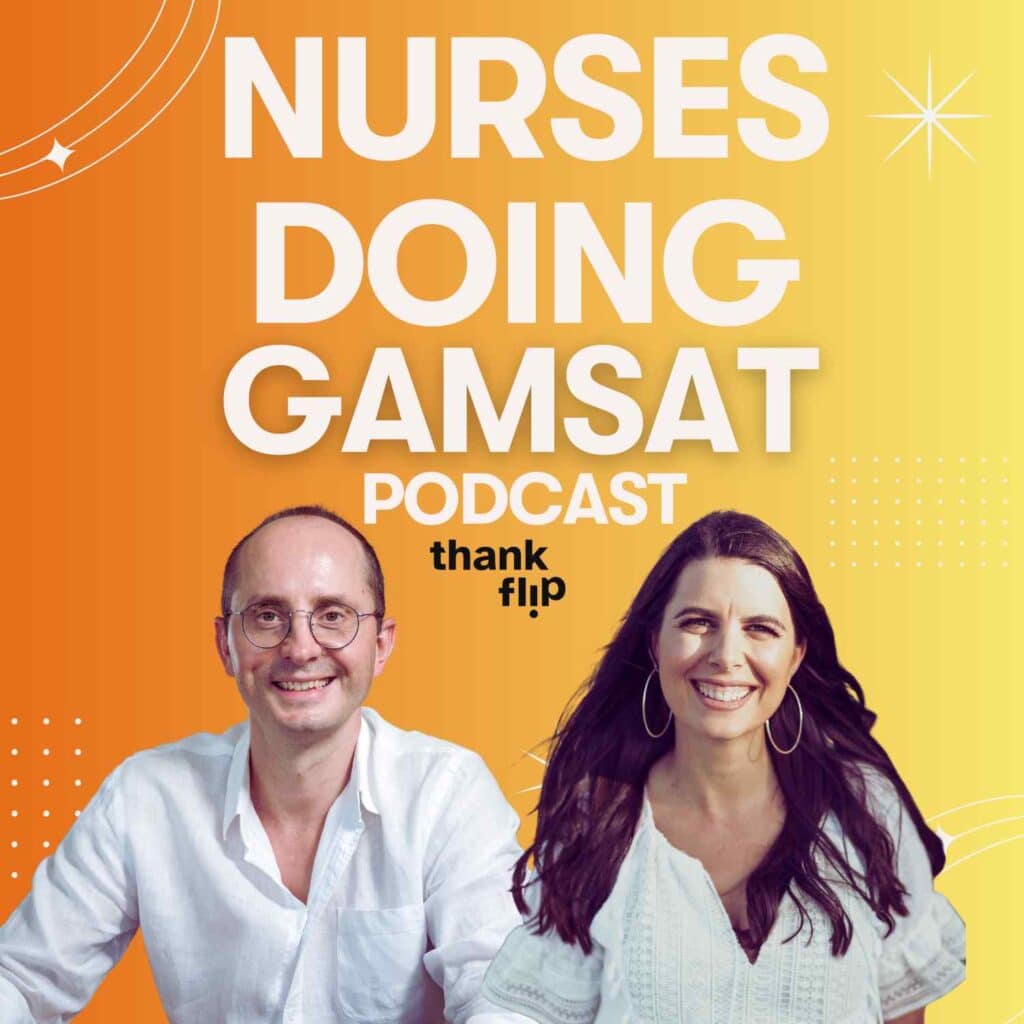
Preparing for the GAMSAT can feel overwhelming, especially when you’re balancing healthcare work, study, and the goal of getting into medical school. In this post-September 2026 GAMSAT debrief, Dr Tom and medical student Vrunda break down what the exam revealed, from Section 1 reasoning skills and Section 2 essay strategies to the unexpected challenges of Section 3. If you’re a nurse or healthcare professional preparing for the GAMSAT, this episode will help you understand what really matters, how to build transferable skills, and how to approach your next sitting with confidence.
Resources Mentioned:
- Join our next GAMSAT training session
- Get the S1/S3 Diagnostic Tests
- Talk to our team about joining our GAMSAT Bootcamp program
- Learn more about our GAMSAT Bootcamp program
Dr Tom Forfa (00:16)
Welcome back, everyone, to the Nurses Doing GAMSAT podcast. I’m Dr Tom, and today we’re doing one of my favourite episodes of the year: the post-GAMSAT debrief, specifically for the September 2026 sitting. The dust has settled, and now it’s time to pick it all apart, see what people have realised, what’s working, what’s not, what happened, and then what we can do with that information to set ourselves up for a fantastic March 2027.
And I’m joined by Vrunda today. Welcome, Vrunda.
Vrunda (00:56)
Hi Tom. Yeah, it’s been a big few weeks. Results are not out yet, but of course everyone’s talking, debriefs are happening, and students have been messaging and sharing how they felt, what threw them off, and what worked well for them too.
And it’s actually one of the most useful things we do because the exam always has something to teach us, and we can always get some insights for next year.
Dr Tom Forfa (01:24)
Exactly. So we don’t yet know the results, but we can understand from what’s happened in the exam what’s important and what’s not.
Vrunda and I are going to use our years of experience to pull that apart and explain what you can take from it. But just to give you a little introduction to Vrunda, because she hasn’t done a podcast with us before, she is a first-year University of Melbourne medical student.
She’s a former Boot Camp member who got, was it 89 in Section 3?
Vrunda (01:54)
Yeah, yeah.
Dr Tom Forfa (01:55)
Yeah, 89 in Section 3, which is a phenomenal score.
She’s also one of our Section 3 tutors as well as one of our study mentors. She works with our students every single week, guiding them through their preparation, understanding what’s working for them, what’s not, how to adjust it, and how to make sure they perform at their best in the actual exam.
And so we’re going to talk about a lot of things in this episode. Make sure you look at the show notes because we’re going to be giving you some resources there as well, particularly the diagnostic test that’s going to help you get set up properly for March 2027.
Use what you learn here to really move forward in a strong way.
Here’s what we’re going to do. We’ll start off by talking about the big-picture insights. Then we’ll break it down into each section of the exam, explain what it means, and discuss how you can use that information moving forward.
So, Vrunda, let’s get started with the big insight from this sitting, which really isn’t much of an insight because we kind of already know it.
And that is: the exam didn’t change.
Preparation levels did.
So let’s talk about that, the whole idea that people think the exam changes with each sitting. You mentioned that before we started recording. What are your thoughts on that?
Vrunda (03:19)
Yeah, so with the GAMSAT, I think there are two ways, or two lenses, that people typically look at it through.
The first lens is looking at it through content, as if you have a content list, kind of like studying for university or high school, where what you cover in the content is what’s going to come up in the exam.
But we find time and time again that this is not really what happens in the GAMSAT. The GAMSAT is about transferable skills, and the thing that never changes is the fact that the GAMSAT is unpredictable.
So every time you sit the GAMSAT, there will always be things where people say, “This was different from last time,” or “This was more,” or “This was less.”
But the core concepts and the core skills being tested in each section, the crux of it, often stay the same.
That’s how we can differentiate between two groups: first-time sitters, who are often like, “Wow, this is so unexpected. Section 3, what is going on? This is crazy.”
And honestly, that’s a positive realisation because that’s when it clicks.
Dr Tom Forfa (04:47)
Yeah, the light bulb moment. That’s it.
Vrunda (04:53)
Exactly. Then you’re like, “Now I know how to prepare.”
And the second group is people who have already sat the GAMSAT. They recognise that there are differences, but they’re able to approach those differences because of their preparation.
They notice the reasoning components and feel like they can navigate some of the uncertainty as well.
They comment more on things like the actual question style rather than just how difficult it was.
Because I think the difficulty is established, and that doesn’t change.
Dr Tom Forfa (05:23)
Yeah, yeah.
And you’re going to see this throughout these podcasts. We found this in the student reports and from what people were saying about this exam.
The people who say, “None of the topics I studied came up,” are often the ones who struggled. They’re not as prepared and they’re not as ready as they could be.
Whereas the people who say, “You know what? It was reasoning. I was able to work my way through it. It was a bit intimidating, but I managed to figure it out,” they’re at another level.
And that’s where we want to be aiming.
But let’s talk about each section one at a time, because I think this is really insightful.
Vrunda (06:01)
Mm.
Dr Tom Forfa (06:02)
Because you’ll often hear that, “Yes, it was different from last time,” but then you speak to your friends and one person says, “I had lots of poetry,” while another says, “I didn’t have much poetry at all.”
It seems different.
My take on that is, firstly, we’re all human beings and we have different impressions of things. We don’t get to see the exam afterwards.
But secondly, we may all get a slightly different paper because they have different questions that they’re testing. These days, it’s even easier to do that than in the old days when we used to do it on paper.
Now they have digital questions, so they can slot different questions in. They can have automated processes where AI helps test the validity of questions as they’re being developed.
That’s my take on it.
But let’s talk about Section 1.
There was a bit of a consensus around this one. Generally, people were saying the passages were a bit shorter.
Vrunda (07:08)
Mm, yeah.
Dr Tom Forfa (07:09)
There weren’t as many of those multi-paragraph stems that we’ve seen in the past, where sometimes you’d have to scroll through a couple of pages of text.
There also wasn’t as much poetry, from what I saw.
There was obviously still a mix between fiction, non-fiction, and what was kind of an unusual twist, which is something we’ve been helping our students with for a while now: these non-fiction, psychology-adjacent texts.
In the past, they’ve had Freud in there. And if you’ve ever read anything by Freud, it can be very dense and very wordy.
It’s non-fiction, but it can be quite difficult to interpret.
What are your memories of doing Section 1? I know it’s not your specialty area, Vrunda, but what are your thoughts on Section 1?
Vrunda (08:16)
Yeah, I remember from my Section 1 that I had a lot of single-quote questions.
I think one of the students this time around experienced something similar, where there were some single-quote questions.
I don’t remember actually getting anything that was very psychology-heavy, which is interesting because that seems to be happening now.
But yeah, it was very non-fiction and fiction-heavy, with a little bit of poetry and cartoons sprinkled in there from what I remember.
Dr Tom Forfa (08:53)
Yeah, so the skills being tested are the same, but the context in which they’re being tested seems to be evolving a little bit.
The Freud-type material has come in over the last couple of years. Single-quote statements have also been coming up a lot.
And yeah, the big takeaway is that there were a lot fewer long passages.
Now, with that said, March might have more long passages, right?
So you still have to be ready for those.
Vrunda (09:27)
Yeah, you never know.
Dr Tom Forfa (09:29)
Exactly.
I think it’s insightful that they’re moving away from those because, perhaps, they’re not as useful in terms of identifying the strongest candidates.
Vrunda (09:46)
Yeah.
I think I can add to that a little bit as well, because I do remember when I did my Section 1, I was implementing some of those very basic literary techniques.
And I think those are still present with students now. You still need to have your basic literary techniques, like how to analyse cartoons, tone, and things like that.
That’s something that will always apply.
I think with the more dense psychology-heavy texts, it’s like they’re trying to throw you off, right?
There are lots of big words that you might not have seen before.
For students who have prepared through the dissection process and focused on reasoning, breaking things apart, and looking for evidence in Section 1, rather than just trying to understand the text completely, that skill becomes applicable to any type of text you come across.
Whether it’s shorter stimuli this time or longer stimuli next time, if you can apply that reasoning process, that’s when you have that light bulb moment.
Rather than trying to read a passage and understand exactly what Freud is trying to say, which you’re not going to be able to do in two minutes.
It comes back to reasoning.
Dr Tom Forfa (11:25)
Yeah, definitely.
Being able to go back into the text and find where the evidence is for that answer.
You’re not expected to know Freud, by the way. You’re not expected to be an expert on Freud, psychotherapy, or anything like that.
It’s about what you’re seeing in front of you in that passage.
Can you interpret what’s going on there? Can you reason and understand the implicit meanings they’re looking for?
The challenge with passages like Freud is, like you said, Vrunda, there are all these words you won’t understand.
But you can still understand the meaning in the context of what you’re reading and pull out what matters.
That’s one of the skills they’re testing.
And those particular questions would probably be distinguishing the really top performers and helping separate them from the rest.
So let’s make sure you guys are in that category.
But yeah, I agree with what you said. The basics are still really important.
We had a student saying that things like identifying tone, humour in cartoons, or the author’s attitude were coming up, and those are the bread-and-butter skills for Section 1.
Dr Tom Forfa (13:01)
Yeah, so this was an interesting insight.
It was balanced across the different types of questions.
A weird, tricky graph question came up, and this is interesting because Section 1 isn’t just English literature. It’s social sciences as well.
That’s when they can bring in graphs on topics like anthropology.
We brought this into Boot Camp this past round much more heavily because we found that it’s not just English literature. There are these social science topics that lean towards almost science-based graph questions.
These have been coming up for years, by the way.
They used to be the ones where you’d get something like the gene pool of some kind of caveman, and you’d have to figure out where they came from or how a virus spread.
It looks like genetics or science, but it actually falls under Section 1.
Vrunda (13:59)
Mm, yeah.
I had an interesting one too because this has unlocked a memory for me.
Dr Tom Forfa (14:05)
A repressed memory, probably, right?
Vrunda (14:11)
I had one where it was instructions on how to tie a knot. It was one of those things you learn in cadets.
It was an image with instructions on how to tie a knot, and then there were questions asking, “What do you do after this step?”
You just had to interpret it.
So that was really strange for Section 1.
Dr Tom Forfa (14:34)
Very unusual.
Vrunda (14:35)
Yeah.
Dr Tom Forfa (14:36)
That wasn’t one of the old practice sample questions they used to give out, was it?
Vrunda (14:40)
I think it might have been.
Dr Tom Forfa (14:41)
I don’t know if it’s in the latest ones, but if anyone can dig up the old ones, that’s something I remember seeing.
That was back about 20 years ago.
Vrunda (14:51)
Mm.
Dr Tom Forfa (14:52)
But yeah, that one has been around for a little while.
That’s a good example.
So yeah, lots of insights there about Section 1.
Let’s move on to Section 2.
Any final words on Section 1 before we move on, Vrunda?
Vrunda (15:05)
I think we’ve covered it all. Yeah.
Dr Tom Forfa (15:07)
Now, by the way, we didn’t coordinate our outfits, but it turned out that we are very matching.
I’m saying great minds think alike. That’s cool.
If anyone is sitting there going, “Did they coordinate?”
Vrunda (15:19)
Mm-hmm.
Dr Tom Forfa (15:21)
I don’t think we could have, even if we tried, but there you go.
Alright, so Section 2.
Let’s start by talking about the topics that actually came up because these are interesting ones.
There were a whole bunch of them because you sit the exam over a weekend. You might do it on a Saturday morning, while your friend does it on a Sunday afternoon, so they need different questions and different topics.
For Task A, we had corporations, volunteerism, scepticism, crowdfunding, and cooperation.
So, kind of bigger-picture topics.
Scepticism probably isn’t something people would immediately expect. That’s interesting.
Vrunda (16:05)
Mm.
Dr Tom Forfa (16:06)
Then for Task B, we had topics like forgiveness, perfection, comparison, and arrogance.
So what are your thoughts on those topics, Vrunda?
Vrunda (16:24)
Yeah, I think it’s nothing different from what has come up in the past.
With Section 2, there are always some topics where you’re like, “How could I have written about that?”
But that happens every single sitting.
There are always topics where people think, “Wow, I would never have thought of that.”
And I think that’s been a big focus in Boot Camp as well: how to come up with ideas.
The Section 2 specialists talk about filters, which are techniques to help you have something to say, even if you don’t immediately know what direction to take.
Dr Tom Forfa (17:06)
Yeah, immediately, right? Straight away, be able to approach it.
Vrunda (17:11)
Yeah, exactly.
Dr Tom Forfa (17:12)
Because some of these topics, like corporations, volunteerism, scepticism, crowdfunding, and cooperation, you might look at them and think, “I could write about maybe two of those.”
But then there are three others where you’re thinking, “What would I even say?”
And like we say, the only topic you can expect is the unexpected one.
There are definitely some unexpected ones here.
Then with forgiveness, perfection, comparison, and arrogance, the key is thinking, “Alright, if I was faced with this, how would I write about it?”
The quotes help as well.
It’s harder when you’re just given the themes, but when you have the quotes in front of you, you can often take an angle from what those quotes are referring to.
Then there are the filters, the booster questions that help you make your ideas stand out, and the “four in 36” technique for coming up with four ideas on each topic in 36 seconds.
But in terms of the big takeaways, I don’t think there are any major changes here. Nothing has really changed.
Vrunda (18:16)
Yeah, it seems the same to me compared to previous years.
And I think with Section 2, the takeaways are often very student-specific.
Some students struggle more with coming up with ideas.
Other students have too many ideas and think, “I don’t know which one to pick.”
Then it becomes like a bit of a salad of different ideas without a clear structure.
Others might struggle with creating an actual paragraph structure.
So it’s very individual.
It’s about reflecting on what you’ve done, what you’ve noticed about yourself, and then realising, “Alright, maybe this is where I need to focus more if I’m doing it again.”
Dr Tom Forfa (19:16)
Yeah, because the GAMSAT doesn’t give you any feedback.
If you’ve just done the exam, they’re not going to tell you, “Hey, you did well on your second essay, but you need to work on your first one.”
They’re not going to say, “You did well in your introduction, but you need to work on your body paragraphs, your evidence, or anything like that.”
There won’t be anything like that.
You’ll just get a score.
And it’s not even your raw score; it’s a scaled score that compares you to everyone else.
So there isn’t much feedback.
But the key thing for Section 2 is firstly: you can’t use pre-memorised responses.
Just looking at those topics, you don’t know which one you’re going to get.
So you can’t really pre-write something and try to force it into every topic.
It’s more about developing the ability to work with what you’re given.
Vrunda (20:01)
Yeah, exactly.
Dr Tom Forfa (20:04)
You need the skills to come up with ideas, to talk about a particular theme, perhaps in the context of something else, or using specific techniques based on the quotes you’re given.
Then you need structures that help you build your ideas, make them stand out, and allow you to draw upon your own experiences, knowledge, or understanding of the topic.
Because you might think, “I could write about crowdfunding and cooperation, but I can’t write about corporations because I don’t really think about that much.”
But you probably can.
There are techniques to help pull those ideas out and make sure you can actually write about the topic.
That’s what you need to work on for the March exam: developing the skills to work with the unexpected topics that come up.
Because again, this is nothing unusual. This is pretty standard GAMSAT.
Vrunda (21:11)
Yeah.
Dr Tom Forfa (21:12)
Alright, so let’s move on to Section 3.
This is your wheelhouse, Vrunda.
Vrunda (21:19)
Yes.
Dr Tom Forfa (21:21)
What have you heard? What have you experienced? What are your thoughts on Section 3 in September 2026?
Vrunda (21:29)
I think I’ll start with what I’ve heard, without adding any extra interpretation.
A lot of students have said they experienced more calculations and maths-based questions.
There were lots of calculations and maths questions, and many students have mentioned this.
There were also lots of graphs and tables, with multiple stimuli. Especially with graphs, some people said they had to flick between graphs and different pieces of information, including some unusual-looking ones that weren’t as straightforward.
Dr Tom Forfa (22:07)
Someone said there was a graph that looked like an eight, right? It was shaped like the number eight, not your standard graph.
Vrunda (22:09)
Eight, yeah.
Exactly.
So again, unexpected.
And then looking at the individual questions, there was a mix.
Dr Tom Forfa (22:19)
Yeah, because people are studying, and they expect it to be chemistry, biology, physics, and those kinds of things.
But then you get all these graphs and calculations.
Vrunda (22:28)
Yeah, and even with chemistry, I think someone mentioned there were a couple of chemistry questions, but they were more IQ-style questions rather than recall-based chemistry questions.
I think that’s a great insight because, again, it goes back to focusing on reasoning skills and transferable skills that you can apply across different topics.
There was also a variety of long and short stimuli.
Some students said it was shorter but more calculation-heavy.
Others said, “That was the longest biology stimulus I’ve ever seen in my life.”
Dr Tom Forfa (23:07)
Yeah, that’s the thing.
That’s the weird thing with the GAMSAT.
Some people will say one thing, while others will say the exact opposite.
Again, this comes back to what I said at the start.
It could be personal interpretation, but more likely it’s because there are different types of questions.
You’re not going to get exactly the same exam as your friend.
It might be mostly the same, but there will be different questions here and there.
Vrunda (23:31)
Yeah, definitely.
I think we can apply the same idea we discussed with Section 1, where we look at first-time sitters compared with repeat sitters.
There’s a bit of a difference there.
With first-time sitters, I think a lot of students were really thrown off because they were like, “Wow, Section 3 is a lot harder than I ever thought it would be.”
And honestly, that’s an expected response.
A lot of people, especially those with a science background, are used to having a curriculum and knowing all the details about physics, chemistry, and biology concepts.
So often first-time sitters focus heavily on those topics and learning the content, rather than developing the skills needed to apply that knowledge in a GAMSAT context.
Then they sit the GAMSAT and think, “Okay, this is actually what they mean. This is what the exam is really about.”
Dr Tom Forfa (24:41)
Yeah.
This is what they’ve been talking about as a different exam.
Now I get it.
Hopefully, you have that realisation before you get to the GAMSAT.
Vrunda (24:45)
Yeah.
Dr Tom Forfa (24:54)
Because it’s possible.
You don’t have to sit the GAMSAT multiple times to have that realisation.
You can understand it before your first sitting.
Vrunda (24:59)
Yeah, definitely.
And I think students who have that realisation, whether it happens before their first GAMSAT or after they’ve already sat the exam, approach things differently.
From the feedback we received, it was less about, “This was an insanely difficult exam,” and more about specific challenges.
They might say, “This time I got weird-looking graphs,” or “This time I got shorter stimuli,” or “This time I had this particular topic.”
They’re able to focus more on the specific elements rather than just thinking, “Wow, this was impossible.”
Because again, every GAMSAT is challenging in different ways.
Dr Tom Forfa (25:44)
Yeah.
I think our interpretation changes as well.
The first time, it feels overwhelming because there are words, topics, and concepts that might seem intimidating.
Someone who isn’t as prepared as they could be might think, “My God, those topics were so hard.”
Whereas someone who has done the work and built their skills before the exam might think, “The reasoning was challenging, but I could work through it.”
They see through the red herrings, the distractions, the big words, and all the different pieces of information.
They see what is actually important.
And that’s something we see every GAMSAT, including this one.
Vrunda (26:43)
Yeah.
I think one of the key takeaways for me, from my perspective, is that they’re really trying to overwhelm you.
They’re trying to scare you.
And it’s important to come to the realisation that this is the purpose. It’s not that you’re unprepared or that you don’t have the skills. It’s that the exam is designed to challenge you with overwhelming information.
If you really think about what the GAMSAT is about, it’s trying to test or differentiate the people who would make it through medical school.
And in medical school, it’s going to be overwhelming. There’s going to be a lot of information coming at you at once, and it can be scary.
It’s not necessarily that the concepts are difficult. It’s that there is so much information.
With Section 3, what they’re trying to get you to do is develop the skills to take a step back, stay calm, look at the information for what it is, find the information you actually need, ignore the red herrings, and work your way through the stimulus to get to the correct answer.
So when you realise they’re trying to overwhelm you, you can approach it from that perspective.
You can think, “Okay, I’m not going to let this overwhelm me. I’m going to stay calm, break down the stimulus, and apply the skills I’ve been learning.”
For example, with graphs, in our acceleration classes we talk about having a step-by-step process.
First, you look at the title and the axes.
Then you scan the text and the accompanying information.
Then you go to the question and return to the information you need.
If you follow that process, you can break down something that initially looks overwhelming into smaller pieces and identify the key information needed to answer the question.
So that was a big insight for me.
Dr Tom Forfa (29:14)
Fantastic.
That was so insightful. Thank you for sharing that, Vrunda.
That was gold.
You can see why Vrunda is one of our Section 3 tutors and study mentors, guiding our students through their preparation.
Fantastic.
Alright, so one of the other insights was about the actual platform where you complete the exam.
Some people mentioned that there was no timer on the screen. In previous years, there has been a timer displayed.
This time, it wasn’t there.
There was one clock in the room.
That means you need to be prepared for these kinds of situations during your actual exam.
We send out a checklist every year of things you need to bring, and one of those things is an analogue clock, just in case something like this happens.
They won’t tell you beforehand.
And they won’t necessarily be very accommodating either.
They’re not going to say, “Sorry, let me get you one.”
They’ll just say, “There it is over there.”
And this has happened before.
Years ago, when we used to sit the exam in huge exam halls with thousands of people in the room, there would sometimes be a clock way at the front.
You’d be squinting trying to see it.
It could be hot, or there could be loud fans blowing.
Some people were cold, some people were hot, and the message was basically: just do the exam.
Vrunda (30:35)
Yeah.
Dr Tom Forfa (30:36)
So again, it’s a distraction.
It’s not technically part of the test, but in a way, it becomes part of the challenge.
Alright, what else came up with Section 3?
Anything else there, Vrunda, from what you’ve heard?
Vrunda (30:57)
I think that’s it in terms of the key takeaways.
I can talk a bit about what I think is worthwhile focusing on for March and preparing for the next sitting.
Dr Tom Forfa (31:10)
Let’s do that.
Let’s shift gears and talk about March and how to best prepare for that.
Vrunda (31:16)
Yeah.
In terms of Section 3, and honestly all sections, I think the biggest thing is focusing on adaptability and transferable skills.
For Section 3, that looks like having processes you can apply to different situations.
For example, with graphs, having a graph dissection technique that you can use for any graph you see, because you will see graphs.
You should also practise your maths and really work on things like logarithms, trigonometry, converting decimals and fractions, and those kinds of skills.
Even basic multiplication, subtraction, and addition are things you can become faster and more accurate at through practice.
These are transferable skills that you can take into the exam.
Dr Tom Forfa (32:18)
Yeah.
And for Section 1, what would be a transferable skill there?
Vrunda (32:26)
For Section 1, it looks like having a process.
For example, with fiction, I’m not sure if they still do this, but a lot of students experience that when you get a question, there’s sometimes a function where you can click on it and it highlights where the answer is in the actual passage.
One technique you can use is to first scan the whole text to get a big-picture understanding.
Then go to the question, go to the specific line, read that line, and read the line above and below to find the evidence.
Sometimes there are things later in the passage that can distract you, but usually they’re looking at that specific point.
Again, it’s not about having one specific technique.
It’s about having a technique you can apply.
The words I usually use are: having a repeatable process.
For all three sections, having a repeatable process that you can fall back on when things become unexpected.
That’s really important.
Dr Tom Forfa (33:32)
Yeah, that’s a good point.
“Repeatable process” is something that we talk about a lot.
We run a free GAMSAT training session on Tuesday nights, and I’ll drop a link into the show notes. That’s where we talk about having this repeatable process for Section 1.
It’s about having a step-by-step process that you apply to the questions themselves, the stimulus material, and the different question types, no matter what topic you’re given.
Vrunda (34:00)
Mm.
Dr Tom Forfa (34:01)
But it’s also about how you think when you’re reading the passage.
You’re not just reading and hoping that, somehow, you’ll intuitively understand what the author means.
I don’t know about you, but I didn’t have any Section 1 intuition. I had more of a science background, right?
Vrunda (34:13)
Yeah.
Dr Tom Forfa (34:15)
It’s about having a systematic approach that you can replicate for different types of texts.
Have one for poetry, one for fiction, one for non-fiction.
So when Freud comes up, or something else that the GAMSAT creators come up with in their “evil lair”…
Vrunda (34:28)
Ha ha ha.
Dr Tom Forfa (34:31)
…or the “evil geniuses” over there who create these questions, it doesn’t throw you off.
That methodology works regardless of the topic.
So go to the show notes and you can learn more about that.
Then for Section 2, it’s the same idea.
You need a repeatable process for coming up with ideas, no matter what the topic is.
Whether it’s a topic you love and want to write about, a topic you hate, like politics, or even something where you’re thinking, “What does that word even mean?”
You need to be able to work with what you’re given.
Then it’s about structuring your essay, structuring your paragraphs, and having evidence to support your ideas.
You need those transferable skills.
Vrunda (35:17)
Yeah, exactly.
I think for all three sections, learning the topics is your baseline.
But learning how to apply that knowledge, and practising how it’s going to appear in a GAMSAT context, is really important.
It’s different from many other exams because you don’t usually have to practise these kinds of skill applications.
For example, you don’t usually have to practise what you’re going to do if you receive a quote you don’t understand.
But with the GAMSAT, that’s something you can practise.
You can simulate those situations.
You can use random quote generators and force yourself to write something.
Don’t Google it if you don’t know it. Just write something.
The same applies to Section 3.
You can practise under timed conditions and practise working through unexpected graphs and unusual questions.
Dr Tom Forfa (36:35)
Yeah.
So that’s a great takeaway.
Transferable skills, practising them early, and then practising them more intensively as the exam gets closer.
The other important thing is understanding where your problems are and getting into detail with that.
I think people often leave it too late, or they don’t want to identify those areas.
Because it’s uncomfortable.
We don’t want to look at the things we’re struggling with. We want to focus only on the things we’re already good at.
But that’s where the marks are hiding.
They’re in those weaknesses, those gaps.
And what that looks like is doing a diagnostic test to figure out where you’re strong, where you’re weak, and whether the issue is knowledge or reasoning.
Then you can work on that.
I’ll drop a link into the show notes for Section 1 and Section 3 diagnostic tests that you can use as well.
But yeah, I think the other major takeaway here is reasoning.
We talk about this a lot.
The GAMSAT is a reasoning test.
Knowledge will only get you so far.
Reasoning is what gets you the rest of the way and helps you achieve higher marks.
So don’t get too caught up worrying about exactly which topics will come up, because hopefully you’ve noticed from this episode that we don’t really know.
And that’s by design.
The exam changes from year to year.
The contexts and topics will change.
But underneath that are the skills: understanding the language of science, the language of English literature, interpreting visual stimuli, and being able to reason through the information in front of you.
Vrunda (38:39)
No, I think even going back to what you said about identifying problem areas, I want to touch on that because I think that’s a really important thing to address.
A lot of people have this fear of failure, and it is uncomfortable, like you said.
But the people who can actually overcome that and improve are the people who are honest about what they don’t understand.
And that’s okay.
You don’t need to judge yourself for that.
But then you have to work on it.
You’re not going to improve your essay writing if you avoid writing essays until the week before the GAMSAT.
And we call this “procrastinate studying”.
Dr Tom Forfa (39:27)
Ha ha.
Vrunda (39:33)
People often do this thing where they know they should be working on a particular tricky physics concept, but they just can’t bring themselves to do it.
So instead, they work on something they already know well.
It feels like they’re being productive, but they’re really avoiding what actually needs to be done.
So I think the key is being honest with yourself.
It’s still early.
You have time until March.
You have time to improve.
Those little things you don’t understand right now are not necessarily a lack of ability.
They’re just gaps in your knowledge or skills, and that’s okay.
It’s actually a great opportunity because you’ve identified it now, rather than two weeks before the GAMSAT.
That gives you time to turn it into a strength or even a superpower by the time March comes around.
Dr Tom Forfa (40:31)
Yeah.
That’s it.
And that’s literally what the study is about.
Some people say, “No, but I don’t know it now.”
Well, you don’t have to know it now.
That’s not the point.
You need to know it by the time the exam comes around, and that’s what studying is for: helping you develop that knowledge and those skills.
And I think this relates to medicine as well.
As a doctor, if you say, “I don’t want to look at this thing that I don’t know. I’m just going to ignore it and focus on something else,” that can be dangerous.
Because people will struggle if you don’t work on the skills or knowledge gaps that you have.
Vrunda (41:08)
Yeah.
Dr Tom Forfa (41:10)
And it’s not a judgement.
It’s not a criticism of you as a person or your ability to succeed.
It’s simply saying, “Hey, there’s a gap here that we need to address.”
Let’s take the steps to fix it.
After you fix that, it may no longer be a problem.
There will probably be something else that you need to work on, but that’s just the process of growth, learning, and education.
Vrunda (41:32)
Exactly.
Dr Tom Forfa (41:35)
And I’m glad you brought that up because one of the challenges with the GAMSAT is that it can bring up a lot of fears, self-doubt, and questions about whether we’re capable of achieving what we want.
Those things are often things we want to avoid, but if they’re there, you can’t just ignore them.
They can show up as procrastination, avoiding difficult tasks, sabotaging your own progress, or distracting yourself with other things.
Vrunda (41:59)
Mm-hmm.
Dr Tom Forfa (41:59)
Unless we kind of say, “Okay, it’s alright that I don’t know these things yet. I need to work through them.”
You might be able to do this yourself.
You might need support from others.
But you do need to work through those challenges alongside the different topics and skills.
And that’s why Vrunda brought this up, because she works with our students regularly and helps guide them through this process.
Vrunda (42:28)
Yes.
Dr Tom Forfa (42:30)
So yeah, great point there.
Vrunda (42:32)
Yeah.
The GAMSAT is kind of like a boiling pot.
It brings up all the things you’ve been avoiding and all the things you might need to work on.
Dr Tom Forfa (42:43)
And it’s also the pathway to your dreams and achieving what you’ve always wanted.
I think that’s true for any goal that is meaningful.
When something really matters to us, we want it badly, but then all those “what ifs” start coming up.
“What if I can’t do it?”
“What if I’m not good enough?”
Those thoughts appear.
And that’s part of what we work on with our students through the GAMSAT mindset component.
Vrunda (43:07)
Yeah.
Dr Tom Forfa (43:07)
We literally have classes focused on this as the exam gets closer.
We run weekly classes to make sure students are at their best.
And this is what athletes and high performers do in any field.
They work on their psychology to make sure that when they face an obstacle, they don’t crumble.
Instead, they work through it.
It’s similar to what happens in medicine.
If a patient is in a resuscitation situation, you can’t panic.
You need to stay calm and work through the problem.
Vrunda (43:37)
Mm.
Dr Tom Forfa (43:38)
The same idea applies here with the GAMSAT.
It’s different with the GAMSAT because the challenge happens on a daily basis sometimes.
It might be physics.
It might be poetry.
It might be essay writing.
Things you don’t enjoy.
But you need to start working through those challenges.
Vrunda (43:53)
Yeah.
Dr Tom Forfa (43:54)
You might be able to do it yourself.
You might need some help, and we can help you with that if you want to know more.
There’ll be a link in the show notes about our Boot Camp, and you can find out more, chat with our team, and see if it’s right for you.
But yeah, awesome.
Thank you, Vrunda.
This has been really helpful.
Vrunda (44:10)
Thank you so much, Tom.
This has been really fun.
It’s been great to debrief as well.
Dr Tom Forfa (44:12)
I know.
This has been great.
We’ve had a lot of notes to go through.
If you guys have any questions, reach out to us.
We’re happy to answer them.
But yeah, all the best, everyone, and we’ll see you on the next one.
Vrunda (44:28)
Yes.
Dr Tom Forfa (44:28)
See you next time.
Watch Now on YouTube:
Ready to Make This GAMSAT Your Last? Book a FREE 1-on-1 Call Now!
Before You Go — Get Your Freebie!
Click here download The GAMSAT Manifesto — our free GAMSAT study guide that has (so far) helped more than 60,000 people crush this highly unusual exam. Oh yeah, and did we mention…it’s free?